
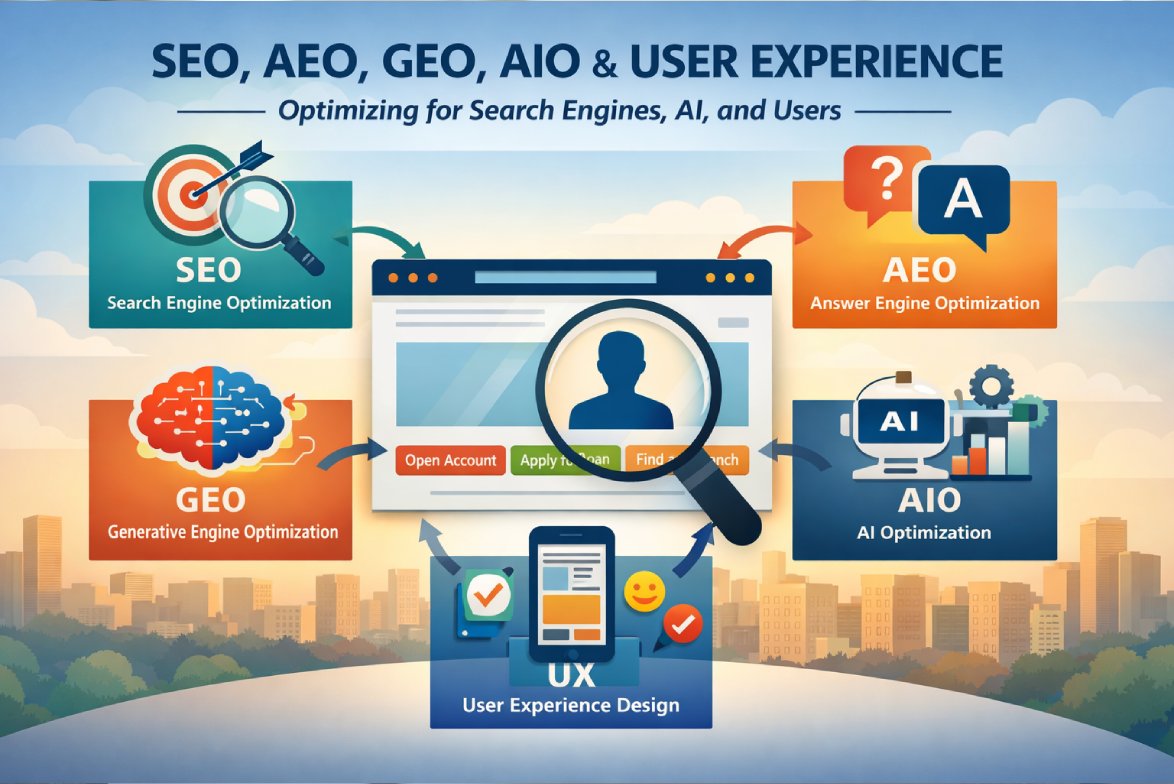
Beyond Keywords: Unpacking SEO, AEO, GEO, AIO, and UX for a Future-Proof Website
Remember when "SEO" just meant stuffing keywords onto a page? Those days are long gone. In 2026, the digital landscape is more complex, conversational, and personalized than ever. To truly stand out and connect with your audience, you need to understand the nuanced interplay between traditional SEO and its more modern, AI-driven siblings: AEO, GEO, AIO, and the ever-critical User Experience (UX).
Let's break down these essential acronyms and how to implement them to build a truly future-proof website.
1. SEO (Search Engine Optimization): The Foundation
SEO is the bedrock of online visibility. It's about optimizing your website to rank higher in traditional search engine results (like Google and Bing) for specific keywords. While it's evolved, its core principle remains: help search engines understand your content so they can show it to the right people.
How to Implement:
- Keyword Research: Identify the terms your target audience uses.
- On-Page SEO: Optimize title tags, meta descriptions, header tags, image alt text, and ensure high-quality, relevant content.
- Technical SEO: Ensure your site is fast, mobile-friendly, secure (HTTPS), and has a clean site structure with proper internal linking.
- Backlinks: Build authority by getting other reputable websites to link to yours.
- Schema Markup: Use structured data to help search engines understand the context of your content (e.g., distinguishing a recipe from a product).
2. AEO (Answer Engine Optimization): Getting Straight to the Point
AEO is a direct response to the rise of "answer engines" and features like Google's Featured Snippets, "People Also Ask" boxes, and now, AI Overviews (SGE - Search Generative Experience). It's about structuring your content so that search engines can easily extract and directly answer user queries, often bypassing the need for a user to click through to your site.
How to Implement:
- Direct Answers: Craft concise, definitive answers to common questions within your content, often in an FAQ format.
- "What is..." / "How to..." Content: Create dedicated sections or pages that directly address user intent.
- Numbered & Bulleted Lists: These are easily digestible formats for AI and answer engines.
- Clear Headings: Use descriptive H2/H3 tags that pose and answer questions.
- Structured Data (again!): Schema markup for FAQs and How-To guides is crucial for AEO.
3. GEO (Generative Experience Optimization): Engaging with AI
GEO is a relatively newer concept, focusing on optimizing content for generative AI experiences, which are becoming increasingly prevalent in search. This goes beyond just providing answers to engaging with the conversational nature of AI assistants and large language models (LLMs). It’s about being discoverable and comprehensible within these AI-generated summaries and dialogues.
How to Implement:
- Contextual Richness: Provide comprehensive, nuanced information that offers depth beyond a simple answer, allowing AI to synthesize richer summaries.
- Conversational Language: Write naturally, as if you're explaining something to a person, which LLMs are designed to process.
- Expert Authority: Clearly demonstrate expertise and trustworthiness in your content, as AI models are increasingly prioritizing authoritative sources.
- Define Jargon: If you use industry-specific terms, define them clearly within your content to ensure AI understands and accurately conveys the information.
- Multi-Modal Content : Consider how your content could be represented not just in text, but also visually or audibly, as generative AI experiences evolve.
4. AIO (AI Optimization): The Holistic AI Approach
AIO is an overarching strategy that encompasses AEO and GEO, but extends to optimizing your entire digital presence for how all types of AI interact with your brand. This includes not just search, but also voice assistants, recommendation engines, and even internal AI systems used by businesses. It's about ensuring your brand is consistently represented and discoverable across the entire AI ecosystem.
How to Implement:
- Natural Language Processing (NLP) Friendly Content: Write in clear, unambiguous language that is easily parsed by AI. Avoid overly complex sentence structures or jargon without clear definitions.
- Voice Search Optimization: Optimize for long-tail, conversational queries that users speak into devices (e.g., "What's the best local coffee shop open now?").
- Entity Optimization: Clearly define your brand, products, and key individuals as "entities" so AI understands who and what you are.
- Data Feeds & APIs: Ensure your product feeds, local listings, and other data sources are clean, structured, and accessible for AI systems that might be pulling information.
- Sentiment Analysis: Pay attention to the overall sentiment around your brand online, as AI can quickly gauge and propagate positive or negative perceptions.
5. UX (User Experience): The Human Factor
Amidst all the AI and algorithms, UX remains paramount. User Experience is about creating a website that is intuitive, enjoyable, and efficient for human visitors. A brilliant SEO strategy means nothing if users land on your site and can't find what they need, get frustrated, or leave. Good UX signals to search engines that your site is valuable, indirectly boosting your other optimization efforts.
How to Implement:
- Mobile-First Design: Ensure your site is perfectly responsive and fast on all devices.
- Intuitive Navigation: Make it easy for users to find information with clear menus, breadcrumbs, and internal linking.
- Fast Loading Speed: Users (and search engines) hate slow websites. Optimize images, code, and server response times.
- Clear Calls-to-Action (CTAs): Guide users on what to do next (e.g., "Shop Now," "Contact Us," "Download Guide").
- Accessibility: Design for everyone, including users with disabilities, by following WCAG guidelines.
- Engaging Content: Beyond just being optimized, your content needs to be readable, valuable, and enjoyable for your human audience.
The Interconnected Web of Success
The key takeaway is that these aren't isolated strategies. They are interconnected threads in the fabric of a successful digital presence. Strong UX ensures your AEO and GEO efforts translate into actual conversions, while effective SEO and AIO ensure your amazing content and user experience are actually discovered.
By understanding and diligently implementing these five pillars, you're not just optimizing for today's search engines, but building a robust, engaging, and future-proof website ready for the evolving digital landscape of 2026 and beyond.